


Why install a heat strip on your Perth alfresco
Perth has one of the best outdoor entertaining climates in Australia for six months of the year. The other six months — from May through to October — most alfresco areas sit empty. The dining table moves inside. The BBQ gets a cover. The pizza oven stops getting fired up on a Tuesday. The space you spent good money on is doing nothing.
A radiant heat strip fixes that. Three reasons we install them across Perth all year round:
- Year-round outdoor entertaining. Radiant heat warms people directly, not air, so it works the moment you switch it on — even in a breeze. The alfresco that was unusable in July becomes the same warm space it was in February.
- Cheaper than glassing in the patio. An alfresco enclosure costs $15,000 to $40,000 in Perth and changes the look of your home. A heat strip install is a fraction of that, fitted in an afternoon, and the alfresco still feels like an alfresco when summer comes back.
- Adds value to the home. A genuinely usable outdoor entertaining area is one of the highest-impact features for resale in Perth. Buyers walking through in winter notice when the alfresco still looks inviting — they imagine using it.
Whether it's a single strip over a small alfresco or three strips covering a full entertaining area, the install is the same one-visit job. Call us on 0483 967 122 with the rough size of your alfresco and we'll have a price for you on the phone.
What actually gets installed
An outdoor heat strip is a sealed black aluminium housing roughly 1100mm long, mounted overhead on a pergola rafter, eave, or patio beam. Inside, one or two infrared elements glow orange-red and radiate heat directly downward to the people sitting below.
The key components of a quality install:
- Radiant element — typically a carbon fibre or quartz tube rated for 1500W to 2400W. Reaches full output in under 30 seconds. No warm-up wait, no fan noise, no smell.
- IP-rated housing — IP55 minimum for covered alfresco areas, IP65 for more exposed locations. Designed to handle Perth's combination of dust, occasional rain, and salt air closer to the coast.
- Hardwired 240V supply — a dedicated circuit run from the switchboard to the unit, with an outdoor-rated cable and a weatherproof junction. Not a power point. Not an extension lead.
- LED-rated dimmer or remote control — lets you run the strip at 50, 75, or 100 percent output depending on conditions. Halves the running cost on milder evenings.
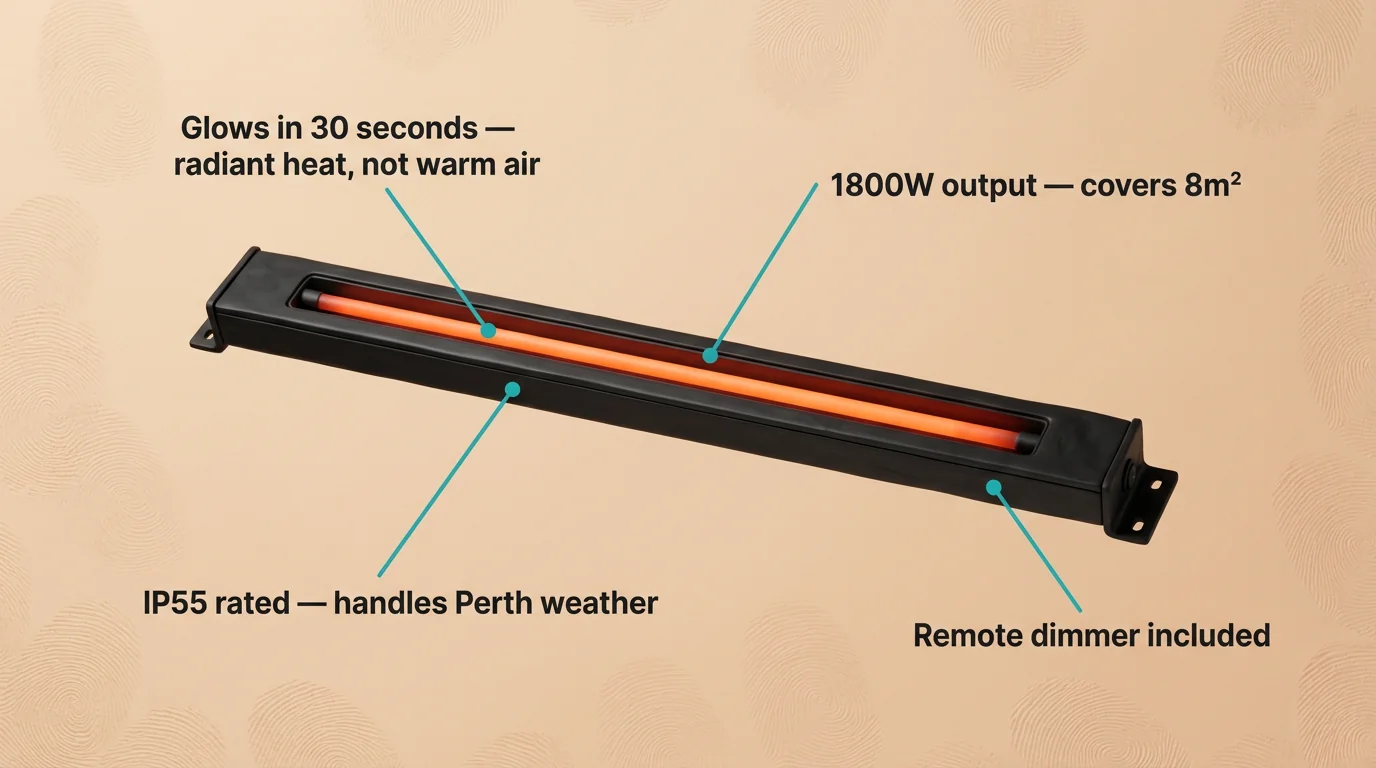
The brands we install in Perth alfresco areas: Bromic (Tungsten and Platinum series — the gold standard, premium and built for the climate), Heatstrip by Thermofilm (Australian-made, mid-premium, strong warranty), Ventair (good value, proper output) and Heatworks. We'll match the unit to your alfresco size, exposure level, and how often you actually use the space.
Three install scenarios we see most
Most outdoor heat strip installs in Perth fall into one of three buckets. Knowing which one you're in helps you describe it on the phone — and we price each one differently.
1. Single strip — small alfresco or focused dining area
One radiant strip mounted overhead, covering 8 to 10 square metres. Suits a small covered alfresco, an ensuite-sized outdoor dining nook, or a focused warm zone over a fixed table. We run a dedicated circuit from the switchboard, mount the strip on the rafter or eave at the manufacturer's recommended height, and fit a weatherproof outdoor switch. One to two hours on site.
2. Upgrade — replacing tired old strips or basic mushroom heaters
You've already got something out there — older strips that are losing output, or those gas mushroom heaters that take up floor space, get knocked over, and need bottle swaps. We remove what's there, supply and fit modern radiant strips with LED-rated dimming, and reuse the circuit if it's compliant. Typical install time is one to two hours.
3. Multi-strip layout — full alfresco coverage
Two or three strips for a 20 to 30 square metre alfresco, mounted at the right spacing for even warmth across the whole area. Run on a shared dimmer or smart controller so the whole zone is controlled together. This is the install for serious entertainers and homes that use the alfresco year round. Two to four hours depending on cable runs and number of strips.
Cafes, restaurants, and pubs with outdoor seating — same principle, different scale. We handle multi-strip layouts for hospitality alfresco zones, including 3-phase circuits for higher output requirements and BMS integration for venues that need it. Talk to us if you're outfitting a venue.
Why a heat strip install is a licensed-electrician job in WA
Outdoor heat strips are 240V, hard-wired, and installed in a damp/exposed location. That puts the work squarely under WA electrical regulations from the moment a screwdriver touches the housing.
Australian Standard AS/NZS 3000 — the Wiring Rules — sets out the requirements for fittings installed in outdoor and partially exposed locations: minimum IP ratings, weatherproof cable terminations, RCD protection, and correct cable type for outdoor use. Get any of these wrong and the install fails inspection and your insurance is exposed.
On top of that, the Electricity (Licensing) Regulations 1991 require a licensed electrician for any 240V install or replacement. That covers fresh installs, upgrades, multi-strip layouts, and any rework that touches the existing wiring. Plug-in patio heaters are technically exempt, but they're underpowered, look cheap, and are not what we install.
All 240V electrical work in Western Australia must be performed by a licensed electrician under the Electricity (Licensing) Regulations 1991. Outdoor installs require RCD protection, weatherproof terminations, and correct IP-rated equipment under AS/NZS 3000. Unlicensed work voids your home insurance. Licence number EC009022.
What the install actually looks like
Every install — single strip, upgrade, or multi-strip layout — runs the same five-step process. We don't deviate from it, and that's how we keep the work consistent across the team.
Phone price estimate
You call us and describe your alfresco — rough size in square metres, whether it's covered or open, where the switchboard is in relation to the patio, and how often you use the space. We give you a price estimate on the call covering the unit, the install, and the dimmer or remote.
On-site walkthrough
We visit and confirm the layout: number of strips, mounting position, cable route from the switchboard, where the dimmer goes, and the exact units we'll install. The walkthrough confirms the final price before any work begins. No surprises.
Cable run and circuit prep
A dedicated circuit is run from the switchboard to the alfresco using outdoor-rated cable. The circuit is RCD-protected at the board. For multi-strip installs, the circuit is sized for total load. Where existing wiring can be reused (upgrades), we test it for compliance first.
Mounting and connection
Strips are mounted to the rafter, eave, or beam at the manufacturer's recommended height — typically 2.1 to 2.4 metres. The unit is hardwired through a weatherproof junction. The dimmer or remote receiver is fitted at an accessible location. All terminations are sealed against weather ingress.
Test and sign-off
Every strip is tested at full output, then through the dimmer range. We confirm the circuit RCD trips correctly. We walk you through the remote or dimmer operation, clean up, and provide a lifetime workmanship warranty on the install.
How to choose the right setup for your alfresco
The four decisions that matter when we're sizing an install. Get these right and the system will outlast the warranty.
How many strips for the area
One 1800W strip covers roughly 8 to 10 square metres of comfortable warmth. A typical Perth family alfresco of 12 to 18m² needs two strips. Larger entertaining areas (30m²+) take three. Going under-spec means people on the edges of the table feel cold; going over-spec means money you didn't need to spend. We confirm the count during the walkthrough.
Wattage and output
Most residential installs are 1500W to 2400W per strip. Higher output for higher ceilings, exposed locations, or larger zones per strip. Lower output is fine for tighter alfresco areas with a low pergola. Don't confuse wattage with size — the strip housing length is similar across the range, but the element rating determines the heat delivered.
IP rating for your location
Heat strips for Perth alfresco areas need IP55 minimum (handles dust, splash, and the occasional rain blow-in under cover). For exposed pergolas with no roof, or coastal locations within a few hundred metres of the ocean, IP65 is the right call. Salt air is harder on outdoor electrical fittings than rain — we confirm the right rating based on your location.
Dimmer or remote control
An LED-rated dimmer lets you run the strips at 50, 75, or 100 percent output depending on conditions. On milder evenings 50 percent is plenty — and uses half the power. On a bitter July night you want full output. A remote control unit is more convenient than a wall dimmer for outdoor use. Either way, this is the part most cheap installs skip — and it's the part that determines how often you actually use the system.
Common questions about heat strip installation in Perth
A single heat strip install in a covered alfresco with reasonable cable access takes one to two hours. A multi-strip install for a larger area — typically two or three strips with a shared circuit and dimmer — takes two to four hours. We give you a phone price estimate based on the size of your alfresco and how many strips it needs, then confirm the final price on site before any work starts.
Most covered alfresco areas in Perth are suitable for radiant heat strips. The unit needs to be mounted overhead — typically on a pergola rafter, an eave, or a patio beam — at the manufacturer's recommended height (usually 2.1 to 2.4 metres). Open patios with no overhead structure require a different approach (free-standing or wall-mounted). During the walkthrough we confirm the right unit and mounting position for your space.
Yes. Outdoor heat strips are 240V hard-wired appliances and must be installed by a licensed electrician under the Electricity (Licensing) Regulations 1991 in Western Australia. Plug-in models are an exception, but we don't recommend or install them — they're underpowered and don't deliver the heat output a Perth alfresco needs. Hardwired strips are the right call. DIY hardwiring is illegal and voids your home insurance.
We install Bromic (Tungsten and Platinum series), Heatstrip (Thermofilm), Ventair, and Heatworks. Bromic is the gold standard in Perth — premium, well-engineered, and designed for the Australian climate. Heatstrip is the Australian-made mid-premium option with a strong warranty. Ventair is the value option that still delivers proper heat output. We recommend the right brand based on your alfresco size, budget, and how often you use the space.
As a rough guide, one 1800W radiant strip covers about 8 to 10 square metres of comfortable warmth in a covered alfresco. A typical Perth family alfresco of 12 to 18 square metres needs two strips for full coverage. Larger entertaining areas (30+ square metres) usually take three strips on a shared dimmer. The actual number depends on ceiling height, exposure to wind, and how warm you want it. We confirm the layout during the walkthrough.
Yes — quality outdoor heat strips carry an IP rating that tells you how much weather exposure they can handle. IP55 is the minimum we recommend for Perth alfresco areas (handles dust, splash, and the occasional rain blow-in). For more exposed locations like uncovered pergolas, IP65 rated units are available. We confirm the right rating for your install location during the walkthrough — it's part of getting the install correct first time.
A typical 1800W outdoor heat strip costs about 50 to 60 cents per hour to run on current Synergy residential tariffs. Most homeowners use them for two to three hours per evening during the cooler months — roughly $1.50 per evening, or $40 to $60 per month of regular use. With an LED-rated dimmer fitted, you can run the strips at 50 percent output when full heat isn't needed, which roughly halves the running cost.