
Why evenings are the tipping point
Perth evenings get darker earlier as winter approaches. Families who barely used their downlights over summer find them running for four, five, six hours a night. That's when old lighting technology gets expensive.
A standard 50-watt halogen downlight running for five hours a day uses 91 kWh per year. Multiply that by 12 downlights — a typical Perth home — and you're looking at over 1,000 kWh just on ceiling lighting. At current Synergy residential tariffs, that's roughly $280–$300 a year.
Replace those 12 halogens with 8-watt LED downlights and the same usage pattern drops to around 175 kWh — a saving of over $230 per year, every year, with no change in how your home looks or feels.
The maths is straightforward. Call us with your setup, get a price estimate over the phone, and we confirm it on site before any work begins. The longer your lights run — and Perth winters guarantee they will — the faster that saving accumulates.
Halogen vs. LED: a direct comparison
Here's what the two technologies actually look like side by side:
| Feature | LED Downlight | Halogen Downlight |
|---|---|---|
| Power consumption | 6–10 watts | 35–50 watts |
| Lifespan | 25,000–50,000 hours | ~2,000 hours |
| Heat output | Minimal | High (fire risk factor) |
| Globe replacement | Rarely needed | Every 12–18 months |
| Dimmer compatibility | LED-rated dimmer required | Standard dimmer compatible |
| IC rating (near insulation) | IC-rated options available | Non-IC — insulation clearance required |
| Colour temperature options | Wide range (2700K–6500K) | Warm white only |
| Annual running cost (50 hrs/wk) | ~$15–$25 per light | ~$85–$120 per light |
Halogen technology hasn't been manufactured for general sale in Australia since the MEPS (Minimum Energy Performance Standards) phase-out. If your home still has halogen downlights, replacement globes are increasingly scarce. The correct long-term solution is a full LED upgrade.
The safety case — not just the cost case
Energy savings get most of the attention, but the safety argument for LED upgrades is just as compelling.
Halogen downlights operate at temperatures between 200°C and 300°C at the fitting. That's hot enough to ignite nearby insulation, timber, or paper if clearances aren't maintained. Over 15 years of service, insulation in your ceiling can shift, debris can accumulate, and what was once a safe clearance may no longer be. Halogen downlights are a known contributing factor in residential roof fires in Australia.
LED downlights, by contrast, run at a fraction of that temperature. Quality IC-rated LED fittings can safely operate in direct contact with ceiling insulation — removing the fire risk entirely.
In Western Australia, all downlight installation and replacement must be performed by a licensed electrician under the Electricity (Licensing) Regulations 1991. DIY electrical work — including replacing halogen fittings with LED — is illegal and can void your home insurance. Licence number EC009022.
What's actually involved in an LED upgrade
Most Perth homeowners picture an LED upgrade as a simple globe swap. In practice, there's more to it — particularly if you want it done correctly the first time.
Phone price estimate
You call us and describe your setup — number of lights, rough ceiling height, whether you have dimmers, and approximate home age. We give you a price estimate over the phone. You know the ballpark before we visit.
On-site walkthrough
We visit and confirm the scope: ceiling insulation type, existing transformer locations, dimmer compatibility, and fitting access. The walkthrough confirms the final price before any work begins — no surprises.
Fitting removal and transformer check
Each halogen fitting is removed. We check whether the existing 12V transformer is compatible with low-wattage LEDs or needs replacing. Mismatched transformers cause flickering and LED failure — this step is not optional.
LED installation and dimmer replacement
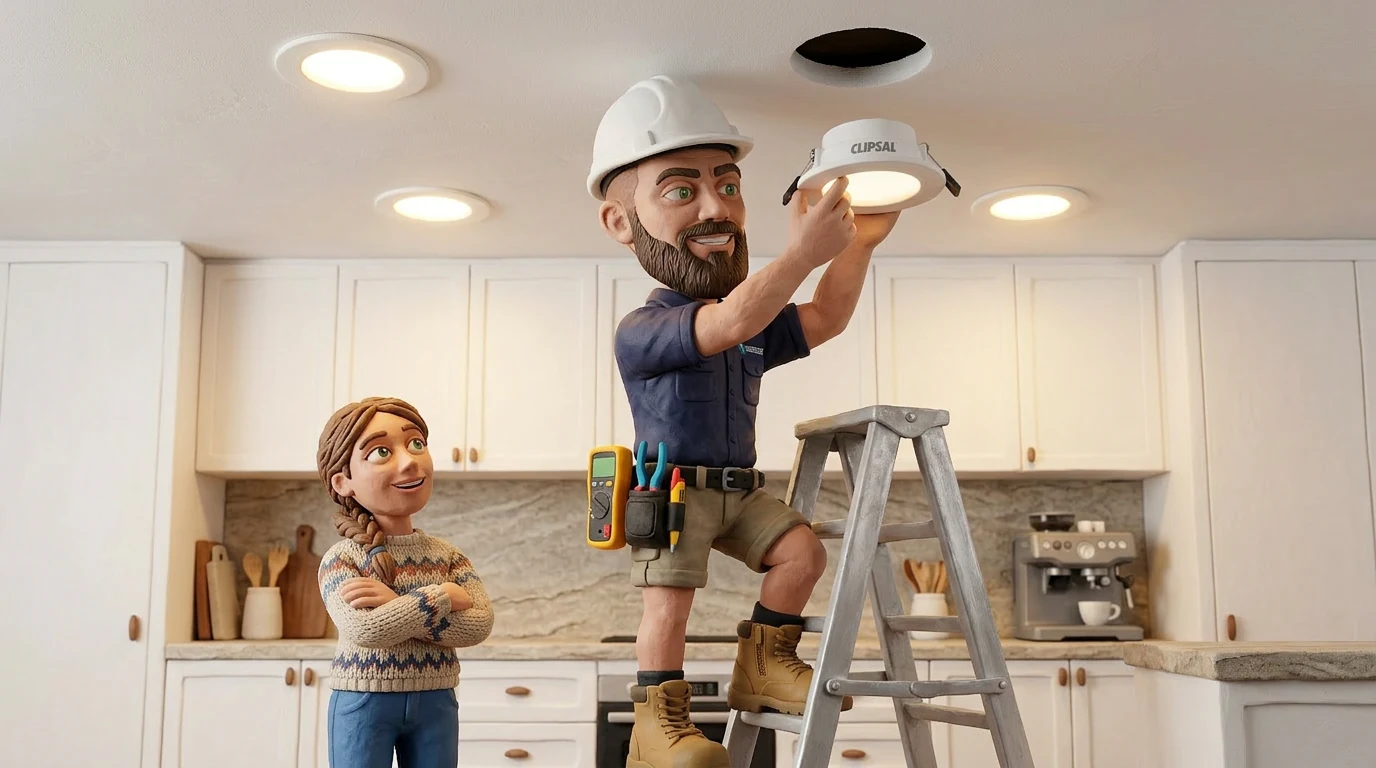
Correct IC-rated LED fittings are installed. Where dimmers are present, incompatible leading-edge dimmers are replaced with LED-rated trailing-edge dimmers. Colour temperature is confirmed with you before we leave.
Test and sign-off
Every circuit is tested. We confirm dimmers operate correctly across the full range. We clean up and provide a lifetime workmanship warranty on all work completed.
What you save with LED downlights in Perth
The financial case for LED upgrades is straightforward. LED downlights use approximately 75–80% less power than halogens — and that saving is permanent. Every year, every quarter, every power bill.
How quickly you recover the cost of the upgrade depends on how many lights you have, how many hours they run, and what your current Synergy tariff is. Perth homes with higher lighting usage — particularly those running downlights across open-plan living areas through the winter months — see the fastest return.
Factors that affect the scope of any upgrade include ceiling access, whether 12V transformers need replacing, and whether existing dimmers are LED-compatible. We work through all of this with you when you call.
You call us on 0483 967 122, describe your setup — number of lights, rough ceiling height, whether you have dimmers — and we give you a price estimate over the phone. The on-site walkthrough confirms the final price before any work starts. No surprises.
The transformer problem most people miss
This is the most common source of LED flickering and early failure in Perth homes, and it's entirely avoidable.
Halogen downlights in older homes typically run on 12V transformers (also called drivers). These transformers have a minimum load requirement — often 20W to 40W per unit. A single 50W halogen fitting meets that requirement comfortably.
Replace it with an 8W LED and the transformer is now severely under-loaded. The result is flickering lights, buzzing, overheating, and premature LED failure. The LEDs aren't faulty — the transformer is incompatible.
The fix is to replace the transformer with a dimmable LED driver rated to the correct output. It's a straightforward job for a licensed electrician and should be included in any proper LED upgrade quote.
If you've had LEDs installed in the past and experienced flickering, there's a good chance this was the issue.
How to choose the right LED downlight
Not all LED downlights are equal. Here's what actually matters:
Colour temperature
Measured in Kelvin (K). Warm white (2700K–3000K) suits living areas, bedrooms, and kitchens. Cool white (4000K–5000K) suits bathrooms, garages, and study spaces. Daylight (5500K–6500K) is harsh in most residential settings. We'll confirm colour temperature with you before installation.
IC rating
If your ceiling has insulation — and most Perth homes built after 1990 do — you need IC-rated fittings. Non-IC fittings require 200mm clearance from insulation in all directions, which is rarely achievable in modern construction. IC-rated fittings can be safely covered. This is non-negotiable from a fire safety perspective.
CRI (Colour Rendering Index)
CRI measures how accurately a light source renders colour compared to natural sunlight. A CRI of 80+ is acceptable for most residential use. CRI 90+ produces noticeably better colour rendering — particularly noticeable in kitchens and artwork lighting. Good-quality LED downlights include their CRI rating on the packaging.
Lumen output
Forget watts — that's a measure of energy, not light. LEDs are measured in lumens. A standard living area downlight should produce 400–600 lumens. Task areas like kitchens benefit from 600–800 lumens per fitting. We'll specify the correct output for your space.
Common questions about LED upgrades in Perth
Yes. In Western Australia, replacing downlights — including swapping halogen fittings for LED — must be carried out by a licensed electrician. This is a legal requirement under the Electricity (Licensing) Regulations 1991. DIY electrical work is illegal and can void your home insurance. A licensed electrician will also ensure the correct IC-rated fittings are used where insulation is present, preventing fire risk.
Call us on 0483 967 122 and describe your setup — how many lights, whether you have dimmers, and the rough age of your home. We'll give you a price estimate over the phone. The on-site walkthrough confirms the final price before any work starts. You'll never be surprised by the final figure.
In most cases, no. Old leading-edge dimmers designed for halogen loads are typically incompatible with LED downlights and cause flickering, buzzing, or early failure of the LED fitting. A licensed electrician will replace incompatible dimmers with LED-rated trailing-edge dimmers as part of the upgrade — we include this in our phone estimate.
LED downlights use approximately 75–80% less energy than halogen equivalents. A Perth household running 12 x 50W halogen downlights for five hours per day uses around 1,095 kWh per year on lighting alone. Replacing them with 8W LEDs reduces that to approximately 175 kWh — a saving of around $230–$280 annually based on current Synergy residential tariffs. Most LED upgrades pay for themselves within three to four years.
IC-rated (Insulation Contact-rated) downlights are designed to safely sit in contact with ceiling insulation. If your home has insulation — which most Perth homes built after 1990 do — your downlights must be IC-rated to prevent overheating and fire risk. Non-IC-rated fittings require 200mm clearance from insulation in all directions. A licensed electrician will assess your ceiling during installation and specify the correct fitting for your situation.
Quality LED downlights are rated for 25,000 to 50,000 hours of use. At five hours per day, that equates to 13 to 27 years of service life. Halogen globes typically last 2,000 hours — roughly 12 months at the same rate. Once upgraded, LED fittings require virtually no ongoing maintenance or globe replacement.
The sale of new halogen globes for general lighting was phased out under Australian MEPS regulations. While you may still have halogen downlights in your home, replacement globes are no longer widely available. Any new lighting installation must meet current energy efficiency standards. Upgrading to LED is the correct long-term solution.